I live and breathe curiosity. I fill nearly every possible free moment with learning. Whether at the gym, taking a walk in the afternoon, or driving in the car, I try to carve out ways to learn more about topics I find interesting.
I am also deeply passionate about being the best I can be. I spend time each morning to organize my day and prepare for the challenges that I will likely face. I think about how I can be the best father and husband as well as how I can best serve the students at my school.
I want to transfer this passion and curiosity to our students in the hope that they can benefit from it. One way I can do that is to implement new technologies into our school. I want to use my knowledge and passion for technology to innovate new ways for our kids to learn and explore.
I’m especially interested in digital fabrication and virtual reality but the fact that technology is always changing and that life has no step by step instructions is what what I find most fascinating. The future is what we make of it. As Berger said, “The ones who understand that-and can embrace that-are going to have the greatest adventures” (2014, p. 200). We have the potential to create new things and new experiences, and that is what excites me most.
REFERENCES
Berger, W. (2014). A more beautiful question: The power of inquiry to spark breakthrough ideas. New York, NY: Bloomsbury.
Last week I wrote a blog post about the survey I sent to our school community to get ideas about how we can best create a makerspace at our school. I have only received one new survey response since then, and that response did not have much of an effect on the results. So far, I’ve heard back from 36 percent of our teachers and administrators. I’m happy to get this response rate during the summer, but I would like to send this survey out again once teachers return to the school to see if I can get more data. I want this project to succeed and to do so, I need to make sure that we hear as many voices as possible.
There have been some changes, though. We are in discussions now with our potential makerspace partner about how we can make a scaled-down version of the offsite class work. As a result of questioning how we can make this happen, I found more new challenges and questions. How can we afford a class when our budget is tight? How can we get kids to an offsite class when we are short on bus drivers? We also need to reevaluate this plan as a whole. Will the benefits be significant enough to be worth the investment?
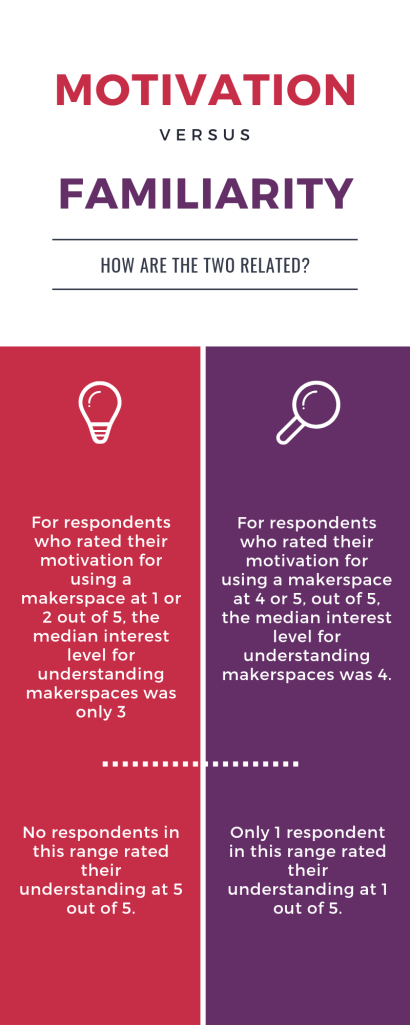
As I mentioned in my first post, there was a strong correlation between knowing what to do with a makerspace and the desire to use it. More knowledge seems to indicate more desire. No respondent who rated their motivation as a 1 or 2 out of 5 said that they had a clear understanding of what a makerspace was. Those who rated their motivation as a 4 or 5 out of 5 had a higher median understanding. Educating faculty is a vital part of having a successful makerspace.
I realized after hearing feedback from peers though that I needed to be more clear that pedagogy would be strongly considered in the training process and in how we use the makerspace. I realized that I didn’t make that thinking clear. In my revised plan I clarified the importance of pedagogy. We need to work closely with teachers to make sure the space works for them and their methods. We also need to keep asking questions like: How will the makerspace complement learning? How does it make it better? When should we not use it? How can we make learning technology in the makerspace relevant by connecting it to lessons in other disciplines?
One of the most important realizations I had this week was that I wasn’t considering the possible negative effects that the space might have for faculty. This is a big change that we are asking our teachers to make. They already have established techniques that they have worked hard to develop and which are working successfully already. We need to respect what is working for them already and be mindful of not interfering with that. We need to keep in mind that change can be difficult.
Aside from being a lot of work to implement, changes can be stressful and confusing. Teachers need to know why this change is important and be an essential part of instigating it (Gentry, 2104). This cannot be a change that is imposed upon them. We have to work with them to figure out how the makerspace can complement their techniques and empower them with knowledge about how to use the space to ensure that they feel they can be successful.
Since each teacher has his or her own personality and each discipline will likely implement the space in different ways, I’d like to have small group meetings with each department to figure out how to make the best use of the space. This will allow us to brainstorm project ideas together that meet the goals of individuals. It will also allow us to more closely connect with faculty, which is vital for motivation. As Berger said: “You just don’t know about people and what drives them until you spend time sitting on the floor listening to someone tell you their story” (2014, p. 179).
Last week I wrote a blog post about how we are working on getting our students access to a makerspace to provide them with new 21st-century learning experiences and to increase their exposure to technology. I sent a survey about this to 56 people, and 20 of those have responded so far. Most of them are experienced teachers from our school community, although many administrators responded as well.
I was surprised to see that over half of the respondents would be willing to give up existing computer labs and carts if doing so meant more money and support could be provided to a makerspace. I did not expect our community to be so willing to part with these resources. We need to investigate further, but I believe as we move towards a formal BYOD program, we could eliminate some of these resources at the Middle/Upper school. Doing so could give us significant funding to purchase a base set of equipment for our makerspace.
I’m excited to get a makerspace working, and I expected to see that same excitement in the survey results, but that was not the case. On average, survey-takers rated themselves at 3.32 out of 5 when asked how motivated they were to use the makerspace.
Interestingly, there seems to be a correlation between understanding of what a makerspace is and the motivation to use it. For example, for respondents who rated their motivation at 1 or 2, the median response for understanding was 3. No respondents in this range rated their understanding as 5. For respondents who rated motivation as 4 or 5, the median response for understanding was 4. Only one respondent in this range rated their understanding as 1.
When asked what the most significant obstacle was to using a makerspace for a class, the most common response was “I don’t know what to do with it,” which had 9 responses. The second most common response was, “It doesn’t apply to my discipline.” This response may be another way of saying the teacher isn’t sure what to do with the makerspace. A makerspace can be used for most disciplines. Of course, we need to keep TPACK in mind and make sure we are doing the best activities to help our students learn. Our teachers know what works best for their own class far better than I do. But it seems reasonable that the motivation to use the space could increase if teachers were given more ideas about how to do it. We may find that makerspace activities may be the best way to teach certain concepts.
Our goal is to give students a learning experience that is relevant to them and involves helping the community in some way. We want them to learn more technology and creative problem-solving. We would like them to learn the value of iteration and that it is ok to fail. It is also important for them to learn to collaborate with businesses, and others in the making community to solve problems.
We thought one good way we could give students a high-quality learning experience like this was to connect with an existing makerspace in the area. We found a partner whose philosophy is very much in line with our own and who could offer us all the things we wanted. However, I was surprised to see that only two respondents said they thought that going offsite to gain access to better equipment was a good idea. The main reason for this response had to do with logistics though several people were concerned that the space would not be readily available for all classes.
Expectancy-value theory says that we are motivated to do things that we value and that we expect to succeed at (Brophy, 1999, Brophy, 2010, Wigfield and Eccles, 2000, Wigfield et al., 2008). In other words, we need to educate and inspire our faculty to use the space if it is going to be successful. We should also create a space onsite, so all faculty and students can access it. My thinglink presentation has more details about this problem and a potential plan for addressing it.
While going through my questions of practice , I found several great goals to achieve. I chose to focus on how we can implement a makerspace or fablab at our school. This is an issue we have been working on over the past few months as part of our technology strategic plan. We want to provide our students with new 21st century learning experiences and to increase their exposure to technology.
Getting access to a good makerspace is not an easy goal to accomplish since it can involve a significant time and money investment. I don’t know that there is a realistic, ideal solution that will make everyone happy. How can we implement a high-quality makerspace to give students a genuine, real-world experience, prepare them for an unknown future and expose them to technology?
We’ve looked into having our students go to an existing fablab that has great connections that would allow our students to work on real-world problems from the start. But that option is costly and not sustainable. We could build an onsite lab that is more sustainable, but we would lose the valuable expertise and connections the offsite lab offers.
I created a survey to get an idea of how others feel about the problem. The survey design was harder than I thought it would be. I wanted to keep it simple so people would complete it. This challenged me to think more about what information is essential. For example, Pierce and Cleary (2016) said that technology is often unreliable and that unreliability often negates its benefit. I wanted to see if our teachers felt this way and if they perceive any other barriers that will need to be removed. This is essential if we are to make our makerspace successful.
While reading “A More Beautiful Question” (Berger, 2014), I thought a lot about innovation. I thought that innovation was an innate skill that only some people possessed, but Berger suggests that the mind can be trained to think differently and that the “What If” muscle can be strengthened (Berger, 2014, p. 114) through mental exercises.
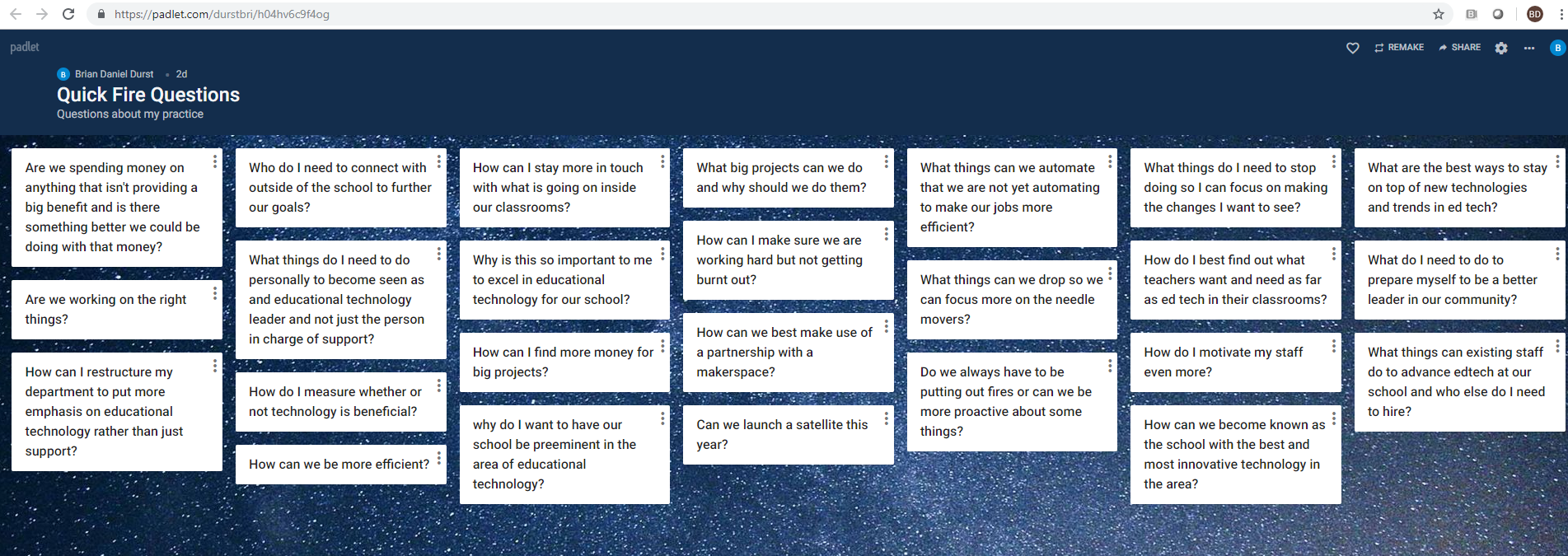
In the video I created, I practiced one such exercise. I categorized the questions I created regarding problems in my practice in multiple ways. This challenged me to organize my thoughts about each question in new ways, and I felt it primed my mind for freer thinking.
This is my second attempt to make a sketchnote-style video. Since I created my brainstorming notes in padlet, it was more efficient to make my thinking visual by moving the cards around while describing my thoughts rather than drawing visual images. It would have been easier to create a more graphic visual representation if I had created my brainstorming notes on individual pieces of paper.
It takes a lot more effort for me to share my thoughts verbally and graphically, so this method of sharing information is not something I plan to use. However, many people (myself included) learn well by watching videos like this so I can see their value.
I experienced some frustrating technical issues while creating the video. To get around them, I needed my iPad to start the project, my work laptop to do edit Padlet, and my work iPad to finish the video. Unexpectedly, these issues made me think about equity. What would I have done if I didn’t have access to a laptop and two iPads? What other advantages do I have that might make a project like this easier for me as compared to someone who has limited access to technology?
REFERENCES
Berger, W. (2014). A more beautiful question: The power of inquiry to spark breakthrough ideas. New York, NY: Bloomsbury.
Questions have sometimes been frustrating for me. I have been in meetings where people are just asking questions and not proposing any practical ideas of how to actually get anything done. It seemed merely philosophical as if they were just thinking out loud rather than doing the work of trying to solve problems. After reading “A More Beautiful Question” by Warren Berger (2014) my perspective has changed a bit. I still believe we need to accomplish something practical in most meetings, but I now think the right questions have the potential to help us think more deeply about our issues and to create a mindset more favorable to innovation.
To experiment with this idea, I did a five-minute “quickfire” brainstorming session to create questions that might help us improve our technology environment. I thought it would be difficult to think of more than a question or two. I had no questions in mind going into the session, so five minutes seemed like a long time. I found that after I thought of the first question though the ideas kept flowing and I didn’t want to stop when my timer went off, so I kept going. In order to maintain flow, I was conscious not to edit my questions. It seemed more natural to let the ideas flow when I formed them in questions rather than statements. Formulating questions created a sense of curiosity about the things I was thinking about, which encouraged me to look for more ideas.
I used Padlet to create a virtual index card for each question. I had thought of Padlet as a tool to be used to encourage engagement and get student or audience feedback in the classroom or during presentations. I did like using it as a brainstorming tool though, and I’d like to experiment with it more in a group session.
So why does questioning matter? One of our school’s core tenets is “To prepare this future generation to deal with the unknown.” Berger (2014) said that workers must learn new skills constantly and that they are “often left to figure out for themselves what new skills will make them more valuable or just keep them from obsolescence.” (2014, p. 20). He said that in the past, we would figure out what our job was and then keep repeating that same work again and again. Things are changing so fast now and with so much complexity that workers continuously need to learn and to figure out what they need to learn (2014). If we are going to prepare our students, we need to teach them to question and to continue learning.
Children show increased creativity and curiosity if we allow them to come up with their own questions and to search for answers to those questions but when teachers are pushed to stick to mandated guidelines, “it can cause them to be less receptive to students’ ideas or inquiries.” (Berger, 2014, p. 47). Questioning also dramatically drops off when students start grade school (Berger, 2014). Are we depriving our students of a valuable skill by mandating what teachers must teach? What can we do to encourage questioning?
I feel fortunate to work at a private school where we aren’t required to teach to specific content standards. In faculty orientation, teachers are made aware that kids will sometimes ask questions that we won’t be able to answer right away. Teachers are encouraged to adopt the attitude of “That’s a great question! I don’t know the answer, but how about we find out together?” I believe this willingness to release the role of the “sage on the stage” and to be a participant in learning right alongside the student encourages questioning and is a great way to model it.
I would like to emphasize the same attitude even more in our technology integration and curriculum. Teaching basic coding is important, but instead of stopping there, we need to keep asking what can we do with this knowledge. Why is it important? What can we do with technology and what experiences can we have that we wouldn’t otherwise be able to?
References
Berger, W. (2014). A more beautiful question: The power of inquiry to spark breakthrough ideas. New York, NY: Bloomsbury.
According to a 2016 survey by the CDC, 6.1% of children and adolescents are diagnosed with ADHD (Center for Disease Control, 2018). ADHD can take the form of inattentiveness, hyperactivity, or some combination of each.
Finding a single technology to assist all students who have been diagnosed with ADHD is an ill-structured problem in that each child can have different symptoms with different severities. There is no single solution that will work for every person and for some students, technology use may be detrimental (Sibley, 2108).
Students with the inattentiveness subtype of ADHD can have trouble organizing tasks, lose items such as planners or homework, be easily distracted, and forget to do regular activities such as homework (Mayo Clinic). However, according to Franklin et al. (2017), tools such as reminders can be used to effectively reduce the effects of mind-wandering and help keep the individual on task.
I looked for an app that could help a specific student organize homework, remind him it was time to do the task, and not be distracting. I decided to implement an app called any.do because it has all of these qualities.
The student can use the app to easily set reminders as soon as homework assignments are given and then receive alerts to do them later. It is simple and doesn’t present distracting information. It allows the student to share lists with a parent in case he or she needs help staying on track.
Though the app is simple, it was not created specifically for people with ADHD. For the student I have in mind it would be ideal if it had only the absolute minimum features. Perhaps that would be a worthwhile project for an app developer.
Franklin, M. S., Mrazek, M. D., Anderson, C. L., Johnston, C., Smallwood, J., Kingstone, A., & Schooler, J. W. (2017). Tracking distraction: The relationship between mind-wandering, meta-awareness, and ADHD symptomatology. Journal of Attention Disorders, 21(6), 475–486. Retrieved from https://doi.org/10.1177/1087054714543494
While creating this video I had a chance to reflect over my life as a maker over the past seven weeks. I was surprised to see how much I’ve done in that short time. I’ve worked on a home addition, built projects with a micro:bit, created worlds in virtual reality, traveled to Mexico and went to an incredible personal development conference in Phoenix. Somehow within all that craziness, I found time to create moments of connection with everyone in my family. That gives me an immense feeling of satisfaction.
In my studies at Michigan State University, we have been thinking a lot about what it means to be a maker and why being a maker is important. We have investigated the importance of being able to make mistakes as students and then going back and fixing those mistakes until we accomplish our goal. We talked about the importance of making our thinking visible and sharing that thinking with others. We also talked about creating projects that are meaningful to us and expressing our learning in a way that is meaningful to us.
It struck me that making is a sort of microcosm of “real life.” We all have goals to accomplish, and those goals are often deeply meaningful to us. We often don’t know exactly which actions will lead us to success, but if we are persistent, if we learn from our mistakes and keep correcting our course, we will ultimately succeed (Martinez, Stager p. 51). And among all of the positive effects that come out of making practicing for success in our life, whatever that means to us, is the greatest benefit.
References
Martinez, S. L., & Stager, G. (2019). Invent to learn: Making, tinkering, and engineering in the classroom (2nd Edition), p. 51. Torrance, CA: Constructing Modern Knowledge Press
This week I’ve been learning about the design of learning spaces and experience design. Much of the media I investigated was specifically related to makerspaces and classrooms, but since I work in the IT office at my school, I attempted to adapt the ideas to our workspace.
I’d like to increase productivity and innovation in our office. I want my team to be proud of their surroundings and for the students to feel proud that they attend an innovative school. I want the school to know that we are working to be nearer to the cutting edge of technology innovation and I want to design a service experience that feels cleaner, more modern, and innovative.
Not only do I want our own office environment to encourage creativity, I’d also like to model what that environment looks like and inspire teachers to make changes in their classrooms. I want to practice these design skills to gain experience so I can assist others in mkaing similar changes.
I created some drawings of what our office looks like now as well as what I would like it to look like:
Current Design
Proposed Design
I considered trying to rearrange the room to encourage collaboration. However, if we had smaller desks we could move our chairs to form a circle in the middle of the room so it’s not necessary to move them. I’d also like to add a larger TV to the wall for collaboration. We currently have one, but it is small and difficult for everyone to see.
Research says that blue tends to encourage both creativity (Mehta and Zhu 2009 pp. 1226-1229) and trustworthiness (Williams, 2009). I chose a cool blue for the walls that I hope will also help keep stress levels lower during some of the more challenging days in our office.
A study by Barret, et al. (p 679-680) confirms what your mom always told you: A cluttered workspace is indicative of a cluttered mind. An office with too many things in it projects the message that the team is too busy or is disorganized which weakens their perceived reliability. Currently, much of the floor space is taken up which feels constricting both physically and mentally. To remedy this issue, I’d like to get smaller desks and remove some of the furniture in the office. We will have less storage in the office once we get rid of furniture but if we only keep the things we use frequently we could move the rest to storage in the server room.
I love this school in Japan that is full of natural light and is connected to nature. I was inspired by it to make some simple changes in our office. Currently, we keep the blinds closed because of the glare the light creates on my monitors. I want to purchase some low-glare filters to put on my screens to see if that allows us to keep the blinds open and allows natural light to enter the room. I’d also like to add some plants to the office, and maybe it would be a good time to get that desk fountain I’ve always wanted.
Our carpet looks institutional and aside from the Phineas and Ferb sculptures we created out of excess metal strips from a wiring project the room has little character. I feel this encourages the “factory model” feeling that Sir Ken Robinson describes (OWP/P Architects p. 56) so I’d like to take out the carpet and use the existing hardwood beneath instead.
Another addition I’d like to make is to work with students to create a technology art installation just inside the office. Ideally, this would be some type of collaborative or interactive art so that visitors to our office can engage with it. I like this idea because it emphasizes the idea that we are a team with our students, promotes a sense of creativity and if done correctly can add to a more techie feel in our office.
I’m looking forward to making these changes to our office beginning next week and continuing into the summer!
References
Barrett, P., Zhang, Y., Moffat, J., & Kobbacy, K. (2013). A holistic, multi-level analysis identifying the impact of classroom design on on pupils’ learning. Building and Environment, pp. 679-680.
Mehta, R. Zhu, R. (2009) Blue or Red? Exploring the Effect of Color on Cognitive Task Performances. Science 27 Feb 2009: Vol. 323, Issue 5918, pp. 1226-1229
In my first post about creating virtual reality (VR) learning experience, I talked about a project in which middle school students design a world, introduce a problem to that world then work with lower school students to find solutions to those problems. They then create that world in virtual reality and share it with their lower school collaborators.
After receiving feedback from peers and doing some additional research I updated the project to make it more complete. For example, fellow Michigan State classmate Lindsay Luft said the following:
Based on her comments, I realized I was not considering that someone else might want to use this plan in his or her classroom. Therefore it would be helpful to list the technologies that I used in the learning experience. So I made a note of which equipment I used along with some general recommendations.
I also work in a private school with a very small student to teacher ratio. This project could require quite a bit of guidance if the students do not have coding experience so that ratio is important to make the experience successful. Based on her recommendations I added a note about that to the learning experience description as well.
I was interested in a comment made by Terence Brown, another peer at MSU:
I love the idea of having students build a collaborative world. This could provide for a richer, more connected experience for the entire class and would give them a chance to practice creative collaboration. Perhaps all of the students could work together on a single story to make it more detailed. I used the Cospaces to create my VR experience so I looked through their forum to see if this option exists, but it looks like it does not. This is an aspect I will keep in mind as I evaluate other design software though.
Like many people, I wonder if the use of VR headsets has any effect on our health. Obviously, if you are walking while wearing a VR headset, there is a chance you could run into something and fall or otherwise injure yourself. But what about the effect on the brain? Would vision be affected? The headset consists of two small screens that are very close to the eyes. Is this safe for the eyes?
According to a 2017 study done by Phillips and Turnbull, people who use microscopes in their work can develop myopia (p. 1). The purpose of the study was to see if myopia or other effects on vision could occur with VR use. Various tests such as binocular vision tests and choroidal thickness measurements were taken before, and after exposure to real-world indoor environments, real world outdoor environments and virtual environments but no negative effects were found (p. 2). They were careful to point out that the exposure time used in the tests was 40 minutes and they hypothesized that it might be possible for issues to occur if the headsets were used for longer times (p. 7).
The University of California conducted a study of rats in virtual environments and found that more than half of the neurons associated with spatial learning shut down compared to neurons used in real environments (Gent, 2016). It’s not clear what effect this has on the human brain and the researchers said that more research is needed. But this finding does give me pause and makes me think we should be responsible about our use of VR. Especially with children.
Since the technology is new, there doesn’t seem to be a great deal of research on the topic. Stanford behavorial neuroscientist Walter Greenleaf has studied the effect of VR on humans says we “should be very judicious” about its use (Lamotte, 2017). I agree and I modified my learning experience to make a note of this. When I design VR lessons in the future, I’m going to limit the time for headset use to short sessions. This is a topic I’d like to monitor in the future as new research is available.
References
Bucher, J. K. (2018). Storytelling for Virtual Reality : Methods and Principles for Crafting Immersive Narratives. New York and London: Routledge.






 Brian Durst EdTech